Places
Imbros Gorge: Length, Ticket, Route and How It Compares with Samaria
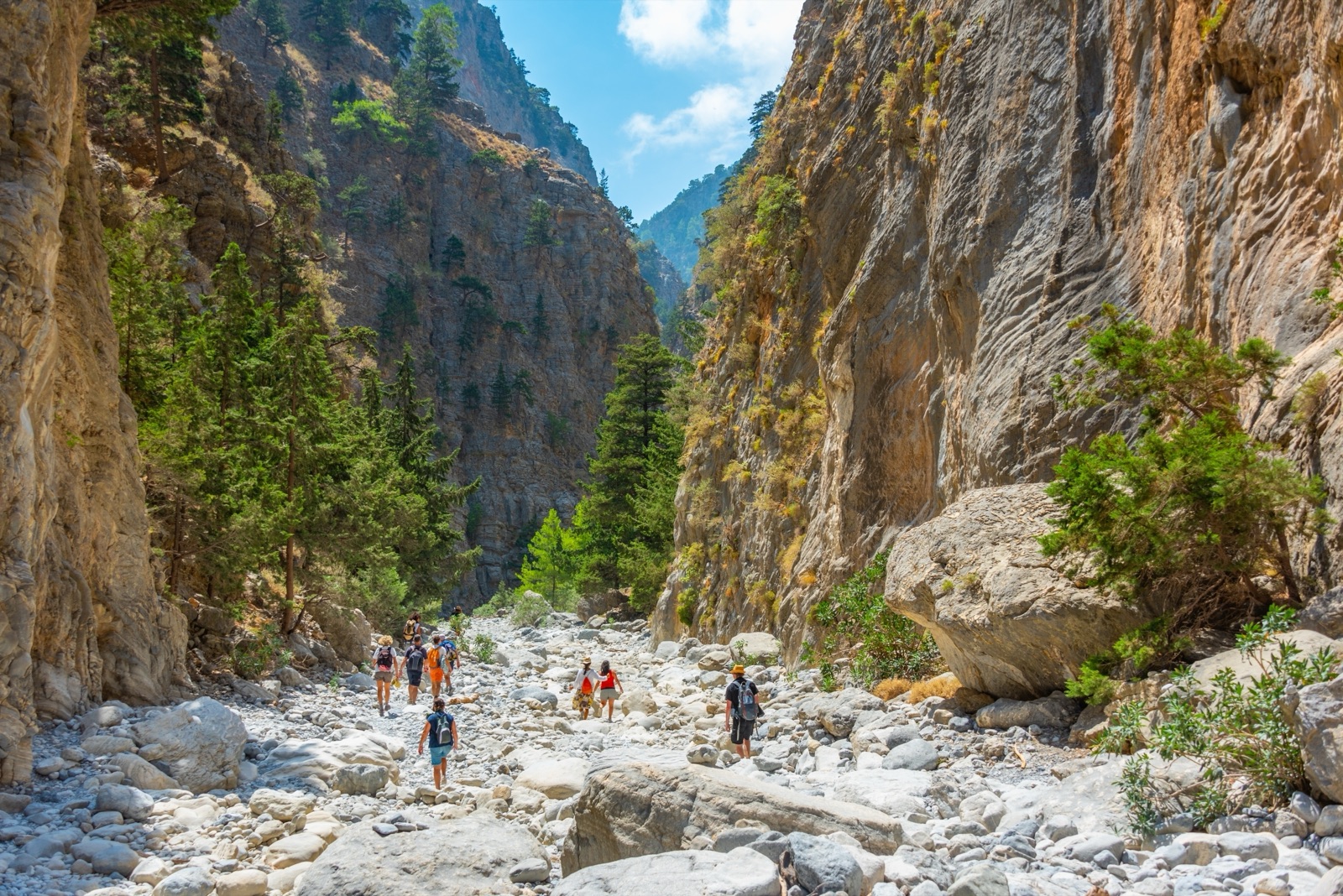
The Imbros Gorge is a short, walkable gorge in Sfakia, on the south side of Crete’s White Mountains, and a separate place from the Samaria Gorge. It runs from just below the mountain village of Imbros, at about 780 m, down to the village of Komitades near the Libyan Sea, at about 200 m. The Region of Crete and the Municipality of Sfakia both give its length as 8 km, and most people walk it in two to three hours. At its narrowest point the walls are only about 2 m apart.
Since March 2026 you need a ticket to enter, sold through NECCA, the national agency that also runs the Samaria ticket. The gorge is the classic alternative when Samaria is closed or feels like too much: it is half the length, it finishes on a road rather than at a boat quay, and the exit is only 4.8 km from Chora Sfakion. This article covers the route, the ticket, how to get there and back, and how Imbros compares with Samaria and the Aradena Gorge nearby.
Imbros Gorge at a glance
- Where: Sfakia, in the south of Chania regional unit. The village of Imbros is 55 km from Chania by road, according to the Region’s tourism site.
- Start and finish: just after Imbros village at the top; Komitades at the bottom.
- Length: 8 km in the Region’s and the municipality’s figures; other public sources give 7 km or 11 km (see below).
- Time: about two hours in the Region’s and the municipality’s descriptions; about three hours according to KTEL, the Chania bus company, and the Region’s UNESCO sites project.
- Narrowest point: about 2 m wide, with rock walls the municipality puts at up to 300 m high.
- Ticket: compulsory since a joint ministerial decision published on 17 March 2026. The Municipality of Sfakia approved a fee of €5 per visitor in 2025; check the current price on NECCA’s ticket site.
- Difficulty: the Region’s page rates it “very easy”; its UNESCO sites page calls it “a relatively easy hike”.
- Water: there are no springs in the gorge, so carry what you need.
Where it is, and how it relates to Samaria
Imbros is not part of the Samaria Gorge or of the Samaria National Park. It is a separate gorge further east in the same municipality, Sfakia, draining the southern slopes of the White Mountains towards the coast between Chora Sfakion and Frangokastello.
The practical difference is how each one ends. Samaria finishes at Agia Roumeli, a village with no road, so every walker leaves by boat. Imbros finishes at the asphalt road along the coast: the Region’s tourism site says the exit is 4.8 km from Chora Sfakion to the west and 10 km from the fortress and beach of Frangokastello to the east. That single fact is why Imbros suits a relaxed half-day, and why its timing is so much more flexible than Samaria’s.
Imbros is also part of the E4 European long-distance path.
How long is the Imbros Gorge?
Public sources give different figures, and the reason is mostly where each one starts and stops counting.
- 8 km, about 2 hours: the Municipality of Sfakia, measured from just after Imbros village to the exit at Komitades. The Region of Crete’s tourism site gives the same 8 km and “about 2 hours” in its text, although its summary box says 3 hours.
- 11 km, about three hours: the Region’s UNESCO sites project, which counts the route from the village itself.
- 7 km, about 3 hours: KTEL’s tourist guide.
For planning, treat it as roughly 8 km of walking and allow three hours plus stops. Fast walkers really can finish in two hours; families, photographers and anyone who likes a long lunch at the bottom will take longer. The height difference is modest by Cretan standards, from about 780 m at Imbros to about 200 m at Komitades, and the path is mostly stony stream bed and old track.
Compared with Samaria, the scale is modest. The Samaria route is about 16 km including the stretch to Agia Roumeli, with an average crossing of 6–7 hours, and it starts from Xyloskalo at 1,227 m. Our guide to walking the Samaria Gorge covers that route in detail.
The ticket
A ticket is now compulsory. NECCA’s ticket site states that the ticket is mandatory for entry into the Imbros Gorge, and that it is a resource of NECCA and of the Municipality of Sfakia under a joint ministerial decision published in the Government Gazette on 17 March 2026. The money pays for the annual maintenance of the main path, repairs and improvements to infrastructure, cleaning, and supervision of the area.
On the price, the clearest public record is the Municipality of Sfakia’s own decision. In August 2025 the Cretan news site cretaone.gr reported that the municipality had approved an entrance ticket of €5 per visitor and was sending the proposal to the environment ministry. The ministerial decision followed in March 2026. Prices and categories can change, so confirm the current fee, and any reductions, on NECCA’s Imbros ticket site before you go.
NECCA’s ticket page lists the Municipality of Sfakia as the body that manages the gorge, and gives the municipality’s phone number for questions about the trail.
When is it open?
For years, Imbros has been described as a gorge you can walk at any time of year. The Region’s tourism site says around 50,000 people cross it each year precisely because it can be walked in any season, especially when Samaria is closed. KTEL and the Region’s UNESCO sites page say the same.
That reputation is still the reason most people come. The Samaria National Park opens from 1 May to 31 October, and its entry window for the full route runs from 07:00 to 13:00. Outside those dates, or on a day when Samaria is shut for weather, Imbros is the obvious substitute. It is so popular in spring that a Greek canyon guide calls April the busiest time of year at Imbros, because agencies that cannot take groups to Samaria bring them here instead.
Now that Imbros has a managed, ticketed trail, treat “open all year” as its traditional description rather than a guarantee. Check the ticket site for the current season and hours, and check again on the morning you walk if the weather is unsettled. The same logic applies here as at Samaria, where the park closes the gorge for a day or more when rain or a heatwave is forecast: a narrow gorge is not a place to be in a storm.
The route, from Imbros to Komitades
The walk begins on the Imbros plateau, on the main road between Askyfou and Chora Sfakion. The village takes its name, the municipality says, from refugees who arrived in 1479 from the Aegean island of Imbros. There are tavernas in the village, and the entrance to the gorge is just beyond it.
The upper gorge
The first part of the gorge is fairly open and gradually closes in. In many places you walk on traces of the old cobbled path that was once the main route between Sfakia and Chania, long before the modern road was built. Trees and shrubs grow straight out of the rock and the stream bed.
The Stenada, the narrowest point
About halfway down, the walls close to form the Stenada, the most striking point of the gorge. Here the rock faces stand less than 2 m apart and rise to about 300 m. It is the Imbros counterpart of Samaria’s Gates, and the place most people stop for photographs. Walk through slowly and let others pass in the tightest part.
The Mesofarango rest area
Just below the Stenada is the Mesofarango, a rest area with a Venetian water cistern. It is a natural place for a snack, but do not count on it for drinking water: the gorge has no springs, so carry enough for the whole walk.
The Xepitira arch
Further down, after another narrow stretch, is the Xepitira, a natural stone arch that has become the gorge’s trademark. Beyond it, after a few more narrow passages, the path reaches the exit near Komitades, with the Libyan Sea in view and tavernas waiting.
What to bring
The walk is short, but it is still a mountain walk on stony ground.
- Water: more than you think you need. There are no springs inside the Imbros Gorge, unlike Samaria, where several springs let you refill.
- Shoes with grip: the stream bed is rocky and loose in places.
- Sun protection: a hat and sunscreen for the open sections at the top and bottom.
- A snack or lunch: there are tavernas at both ends but nothing in the gorge itself.
- Your ticket: bought in advance and kept to hand.
- Cash or a card: for a taxi back up the hill, the bus, or lunch in Komitades.
Getting to the start
By bus
Imbros village sits on the road from Chania to Chora Sfakion, and KTEL says visitors can reach the area on its Chania–Sfakia bus route. Ask the driver to drop you at Imbros. Timetables change through the year, so check the current printable timetable on KTEL’s website for the morning departures and for the return. Buses back to Chania from Chora Sfakion include the 18:30 service that waits for the evening ferry from Agia Roumeli.
By car
Driving is the simplest way to fit Imbros into a day. The standard plan, described in the Greek canyon guide, is to leave the car at Imbros, walk down, and take a taxi back from Komitades. Strong walkers can also walk back up the gorge to the car, since, the guide says, the climb is not too tiring; allow more time for the ascent than the descent.
Getting back from Komitades
The exit brings you out beside the coast road, not in a remote cove, and that is the great convenience of Imbros.
- To Chora Sfakion: 4.8 km west. From there you can take the bus back to Chania or a boat along the coast.
- To Frangokastello: 10 km east, for the Venetian fortress and its sandy beach.
- To Imbros: back up the road by taxi if you left a car at the top.
Komitades itself is a small village at about 200 m, surrounded by olive groves, with rooms and tavernas. Its church of St George has frescoes dated 1314, and to the south-west is the Monastery of Thymiani, where, the municipality notes, the revolution in Sfakia was declared on 29 May 1821.
For more on Chora Sfakion, Frangokastello and the car-free village of Loutro, see our article on Loutro and the Sfakia coast.
A sample Imbros day
- Morning: drive or take the bus from Chania to Imbros village, have your ticket ready and start walking.
- The walk: down through the open upper gorge, the Stenada and the Xepitira arch, about three hours with stops.
- Lunch: at one of the tavernas at the exit in Komitades.
- Afternoon: 10 km east to Frangokastello for a swim below the castle, or 4.8 km west to Chora Sfakion.
- Evening: the bus back to Chania from Chora Sfakion, including the 18:30 departure that waits for the ferry from Agia Roumeli, or a boat along the coast to Loutro for the night.
Because the exit is on a road, the order is flexible. On a hot day, walking early and saving the beach for the afternoon is the more comfortable way round.
A path with history
The Imbros Gorge was the main route by which Allied troops retreated across the White Mountains at the end of May 1941, after the Battle of Crete. They came down through the gorge to Komitades and Chora Sfakion to be taken off by ship to Egypt. The Municipality of Sfakia says several thousand Allied soldiers, mostly Australians and New Zealanders, gathered at Chora Sfakion, and a monument stands by the road to the port.
Imbros, Samaria or Aradena?
Sfakia has several walkable gorges. Here is how three of them compare.
| Samaria | Imbros | Aradena | |
|---|---|---|---|
| Length | about 16 km including the walk to Agia Roumeli | 8 km in the municipality’s figure | 7 km in the municipality’s figure |
| Time | 6–7 hours on average | about 2–3 hours | 3.5 to 4 hours |
| Ticket | €10.00, NECCA | compulsory; €5 approved in 2025 | sold through NECCA |
| Season | 1 May to 31 October | traditionally all year; check the ticket site | check the ticket site |
| Finish | Agia Roumeli, by boat only | the coast road at Komitades | Marmara beach, then boat or path |
Samaria
Samaria is the big day: a long descent from the Omalos plateau to the sea, the Gates, the abandoned village, and a boat at the end. It needs an early start, a fixed timetable and a reasonable level of fitness. If you have one day for a gorge and Samaria is open, it is the classic choice. Our getting to Samaria guide sets out the buses, the entry window and the boat back.
Imbros
Imbros is the relaxed option: shorter, lower, flexible about start times, and with no boat to catch. It suits families, a first walk to test your legs, a day when Samaria is closed, or a half-day that ends with a swim at Frangokastello. The trade-off is that it has no springs and far less of Samaria’s sense of scale.
Aradena
The Aradena Gorge, west of Chora Sfakion, starts at the village of Aradena beside the iron bridge used for bungee jumping and ends at Marmara beach. The municipality gives 7 km and 3.5 to 4 hours, so it is slower going for its length than Imbros. From Marmara you continue by boat to Loutro or on foot along the coast path, so it needs more planning than Imbros. NECCA sells tickets for it too, and it is also managed by the Municipality of Sfakia.
Walking Imbros with a guide
Imbros is easy to walk independently, but guided day trips to Imbros also run from Chania and take care of the transport at both ends. If you would rather walk Samaria, the organised days from Chania include a hiking-guide option with a safety briefing and the ferry from Agia Roumeli. The tours page lists the Samaria trips with live prices.
Frequently asked questions
How long does the Imbros Gorge take?
Most people take two to three hours. The Municipality of Sfakia gives about two hours for its 8 km; KTEL and the Region’s UNESCO sites page give about three hours. Allow extra time for stops and for the walk or taxi from Komitades.
Is there an entrance fee for the Imbros Gorge?
Yes. A ticket has been compulsory since a joint ministerial decision published on 17 March 2026, sold through NECCA. The Municipality of Sfakia approved €5 per visitor in 2025; check the current price on the ticket site before you go.
Is the Imbros Gorge open when Samaria is closed?
That is its traditional role: the Region of Crete describes Imbros as walkable at any time of year, especially when Samaria is closed. Now that the trail is ticketed, check the ticket site for the current season, and do not enter in heavy rain.
How do I get back to the start of the Imbros Gorge?
The exit at Komitades is on the coast road, 4.8 km from Chora Sfakion. Take a taxi back up to Imbros if you left a car there, or walk back up through the gorge. Without a car, continue to Chora Sfakion for the bus to Chania.
Is the Imbros Gorge suitable for children?
It is shorter and lower than Samaria, the Region’s page rates it very easy, and the Greek canyon guide calls it ideal for families with children. Children still need proper shoes, water and sun protection, and the stony stream bed calls for care.
Is there water in the Imbros Gorge?
No. There are no springs inside the gorge, so carry all the water you need. Tavernas at Imbros and at the exit in Komitades are the places to refill.