Walking the Samaria Gorge: The Route, How Hard It Is, What to Bring and How to Stay Safe
The Samaria Gorge is not a technical climb, and people of many ages and fitness levels complete it every season. But it is a long, rocky descent, often in strong sun, with no way out except forwards or back. Knowing what the path is like, how long it takes and how to look after yourself turns a gruelling day into a memorable one.
This guide describes the walk from top to bottom, explains how demanding it is, lists what to bring, sets out the park’s rules, and covers the safety advice the rangers give every visitor.
The walk in numbers
- The path inside the gorge is 13 km, plus 3 km from the south entrance to Agia Roumeli: about 16 km in all.
- The natural direction is downhill, from Xyloskalo at 1,227 m to sea level at Agia Roumeli.
- An average crossing takes about 6–7 hours.
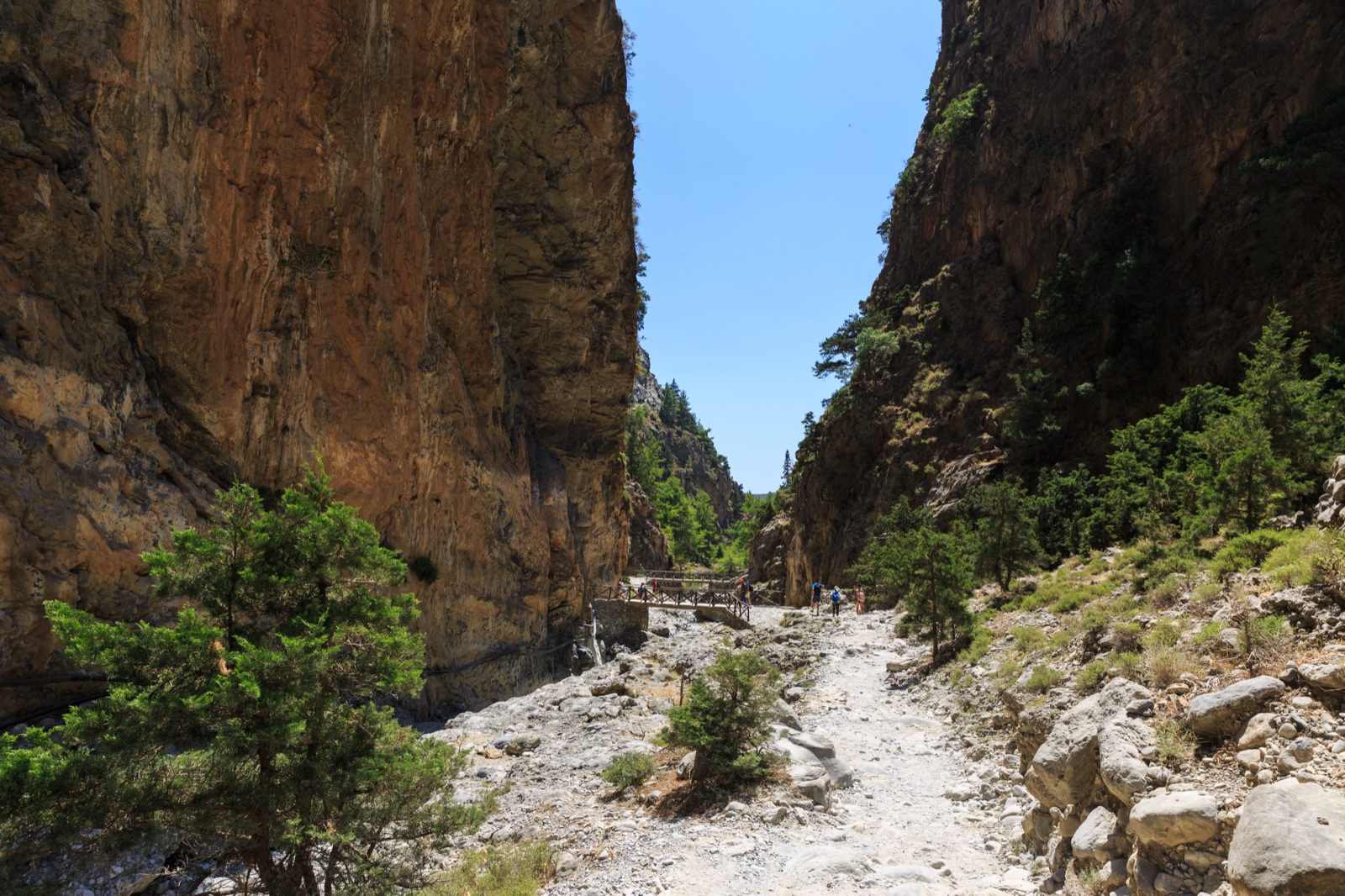
- At the Gates the sides of the gorge close in to only four metres apart and rise almost 300 m.
How hard is it?
The path is mostly rocky and crosses the river several times on small wooden bridges or stepping stones; it is not an easy walk, but it is not only for experienced hikers. The main challenges are:
- The descent. Going from 1,227 m at Xyloskalo down to sea level is hard on knees and thighs, especially in the steep first section.
- The terrain. Rocks and loose stones underfoot for much of the way demand attention and good footwear.
- The distance. About 16 km is a full day, and fatigue builds towards the end.
- The heat. In summer, the lower gorge can be very hot; the gorge can close for a day or more if rain or a heatwave is expected.
Anyone reasonably fit and used to walking can do it with sensible preparation. The key is to treat it as a full day in the mountains rather than a stroll: start early, eat and drink regularly, and let the slowest member of your group set the pace. People who struggle usually do so because they rushed the first descent or ran short of food and water, not because the path itself is beyond them. Walk slowly and take several stops, as the park advises.
Why the gorge is here
The gorge was carved by a small river between the White Mountains and Mount Volakias. Over a very long time, that stream cut down through the rock, creating the deep, narrow canyon you walk through today. Its wildness is protected: the gorge became a national park in 1962, and UNESCO has designated the gorge a Biosphere Reserve. Every rule on the path exists to keep it that way.
The route, from top to bottom
Xyloskalo and the descent
The walk begins at the northern entrance on the Omalos plateau. Xyloskalo, ‘wooden stairs’, is named after an old staircase of cypress trunks; the trail, built by Manousos Koundouros in the late 19th century, is 2–2.5 m wide. The first stretch zigzags steeply down through the forest, with views across the gorge to the peaks of the White Mountains. Take it slowly: this is where tired knees are made.
The first two kilometres
The steepest descent comes early. The rest area at Neroutsiko marks the end of the first 2 km, the stretch that later arrivals may walk from the top. The rangers’ advice starts to matter here: the emergency number is 112; after the 2nd kilometre, note where the riverbed is, as a refuge in case of danger.
Into the gorge
Below the steep section, the path levels out and follows the riverbed through woods and open stretches, crossing the stream several times. The wooden bridges are removed in winter so the torrents do not sweep them away, which is one reason the gorge opens only in the warmer months. Rest areas, springs and toilets are spaced along the way.
The village of Samaria
Further down lies the abandoned village that gave the gorge its name. The village of Samaria, inside the gorge, was abandoned by its last inhabitants in 1962; the village and the gorge are named after its ancient church, Ossia Maria. It is a natural place for a longer rest. The ruined houses and the old church are a reminder that people lived in this remote place until the park was created, far from any road. Sit in the shade, refill your bottle and eat something before the second half of the walk, which feels longer than it looks on the map.
The narrowing gorge
Below the village, the walls close in and grow higher. The gorge becomes deeper and more dramatic, and the path weaves between boulders and across the stream.
The Gates
The climax of the walk is the narrowest point. At the Gates the sides of the gorge close in to only four metres apart and rise almost 300 m. The Portes (Gates), the most famous sight in the gorge, are about 1.5 km from the Agia Roumeli outpost. Take your time here; it is the moment most walkers remember. Pause before you enter, look up at the walls, and let others pass if the path is busy; there is no hurry once you are this close to the end.
The exit and Agia Roumeli
Beyond the Gates, the path continues towards the sea. At the southern entrance, your ticket is checked. Keep your ticket to be checked at the exit, so the rangers know everyone who entered has left. From there, it is about 3 km to the village and the beach, or a private minibus at the gorge exit can take you to Agia Roumeli, saving the last kilometres.
Water, food and facilities
- Water: there are several springs inside the gorge where you can refill your water bottle. Start with a full bottle anyway.
- Food: there are no shops inside the gorge, so bring food.
- Toilets: there are toilets in several places along the path.
- Rest areas: spaced along the route, and the only places where smoking is allowed.
What to wear and bring
- Footwear: walking shoes or boots with good grip and support; the rocks are unforgiving.
- Clothing and sun protection: visitors need suitable clothing, footwear and sun protection (hat and sunscreen).
- Medication: bring any medication you may need, and report health problems to the park rangers.
- Food: a packed lunch and snacks for the day.
- A refillable bottle for the springs.
- Swimwear for the sea at Agia Roumeli.
- Your ticket and money for the boat and bus.
Walking poles help many people on the descent, and a small first-aid kit for blisters is worth its weight.
Staying safe
The gorge’s beauty hides real hazards, and the park is clear about them.
- Falling rocks: follow the rangers’ instructions and the signs, especially about falling rocks, and never leave the main path.
- Fire: watch the five-level daily fire hazard index and report any smoke immediately.
- Emergencies: call 112, and remember the riverbed as a refuge after the 2nd kilometre.
- Pace: walk slowly and take several stops.
- Heat: start early, drink regularly and rest in the shade.
- Time: everyone must leave the park by 18:00, so keep an eye on the clock.
The park rules
The gorge is a national park, and its rules protect both visitors and the landscape.
- Camping in any form and staying the night in the park are prohibited.
- Swimming in the park’s rivers and streams is prohibited.
- Drinking alcohol is prohibited in the park.
- Smoking is allowed only at the rest stations.
- Dogs are allowed only on a lead.
- Do not pick plants, disturb wildlife or leave rubbish; use the bins along the path.
Wildlife
The gorge became a national park in 1962, especially as a refuge for the rare kri-kri, the Cretan wild goat. Kri-kri are shy, so consider any sighting on the slopes a bonus. The park’s protection also covers the plants that cling to the rock walls, which is why picking them is forbidden.
Walking with a guide
Many people walk independently, but a guide adds reassurance and interpretation.
Samaria with a hiking guide. The 16 km gorge from Chania with a hiking guide carrying radios, a safety briefing before you start and the ferry from Agia Roumeli. About 14 hours door to door.
Full-day trek from Chania. Coach to Omalos in the White Mountains and breakfast, then the walk at your own pace to Agia Roumeli.
The tours page lists them all with live prices. For buses, boats and tickets, see how to get to the Samaria Gorge.
Common mistakes
- Starting late. Entry for the full route closes at 13:00, but a late start means walking in the hottest hours and racing for the 17:30 boat.
- The wrong shoes. Fashion trainers and sandals struggle on the rocks; blisters and turned ankles are the result.
- Too little food. There are no shops in the gorge, and 6–7 hours of walking burns a lot of energy.
- Rushing the descent. The steep first section is where knees suffer; slow down, and use poles if you have them.
- Ignoring the signs. Falling rocks are a real hazard, and leaving the main path is prohibited.
- Forgetting the ticket. It is checked at the exit, so keep it with you.
- Underestimating the heat. Carry sun protection, refill at the springs and rest in the shade.
Walking in different seasons
- May and June bring the start of the season, with long days and, often, milder temperatures than high summer. If the weather is good and the path undamaged after winter, the gorge can open earlier, but not before 10 April; it can also close early if a storm damages the path.
- July and August are the busiest and hottest months. Start as early as possible, and be ready for heatwave closures.
- September and October bring cooler walking, but also the first autumn storms: rain closures become more likely, and wind can stop the boats from Agia Roumeli.
- The park closes in winter, when the wooden bridges are taken down and the stream becomes a torrent.
Shorter walks
If the full descent is too much, the park allows shorter visits:
- From the top: you can also walk just a few kilometres in from Xyloskalo, but the return is tiring because the path is steep.
- From the bottom: the Portes (Gates), the most famous sight in the gorge, are about 1.5 km from the Agia Roumeli outpost, so a walk up from the sea reaches the highlight with far less effort.
- In the afternoon: after 13:00, visitors may walk only the first 2 km from either entrance.
Before you set off: a checklist
- Ticket bought, and saved on your phone or printed.
- Closure status checked the evening before and in the morning.
- Bus and boat times noted, including the 17:30 boat from Agia Roumeli.
- Shoes broken in and socks that will not rub.
- Food and a full bottle packed.
- Sun protection and a hat ready.
- Medication and a small first-aid kit in your bag.
- Swimwear for the sea at the end.
Pacing the day
- The first hour: the steep descent from Xyloskalo; go slowly and save your knees.
- Mid-morning: the gentler middle section, with rests at the springs.
- Midday: the village of Samaria, for a longer break and lunch.
- Early afternoon: the narrowing gorge and the Gates.
- Mid-afternoon: the exit, the ticket check and the walk or minibus to Agia Roumeli.
- Late afternoon: a swim and a meal before the boat.
After the walk
At Agia Roumeli, the reward is the sea. Swim to ease tired legs, eat something substantial, and rehydrate before the boat. The park advises staying overnight in Agia Roumeli rather than making a day trip, and after a long descent, a night by the sea is a pleasure rather than an indulgence.
Photography
- The view from Xyloskalo over the gorge in the early morning light.
- The forest and the river in the middle section, with the stream crossings.
- The village of Samaria, abandoned in 1962.
- The Gates, where the walls almost touch; a wide lens helps capture the height.
- Agia Roumeli and the Libyan Sea at the end.
Walking with children and older walkers
There is no age limit, but the long, rocky path is not recommended for small children, and children must never be left unattended in the gorge. Older children who walk regularly usually cope well, especially if the day is paced with plenty of stops. For younger children, or anyone who finds long descents difficult, the walk up from Agia Roumeli to the Gates gives a real taste of the gorge in a fraction of the distance.
Etiquette on the path
- Keep right and let faster walkers pass on narrow sections.
- Do not stop in the narrowest places, such as the Gates, where others need to get through.
- Use the bins and toilets provided; never leave litter.
- Keep noise down; the gorge is a refuge for wildlife as well as a path for people.
- Help others who are struggling, and tell a ranger if someone needs assistance.
Accessibility
The gorge is not suitable for wheelchairs or for anyone who cannot walk long distances over rough ground. The path is rocky, the first section is steep, and the river crossings use small bridges and stepping stones. The coast at Agia Roumeli, reached by boat, can be enjoyed without walking the gorge.
Frequently asked questions
How long does it take to walk the Samaria Gorge?
About 6–7 hours on average for the full 16 km from Xyloskalo to Agia Roumeli.
Is the Samaria Gorge walk difficult?
It is not technical, but it is long and rocky, with a steep descent at the start and several river crossings. It is not an easy walk, but it is not only for experienced hikers.
Is there water in the gorge?
Yes. There are several springs where you can refill your bottle, and toilets along the path. There are no shops, so bring food.
Can I swim in the gorge?
No. Swimming in the park’s rivers and streams is prohibited. Swim in the sea at Agia Roumeli instead.
Can I bring my dog?
Yes, but only on a lead.