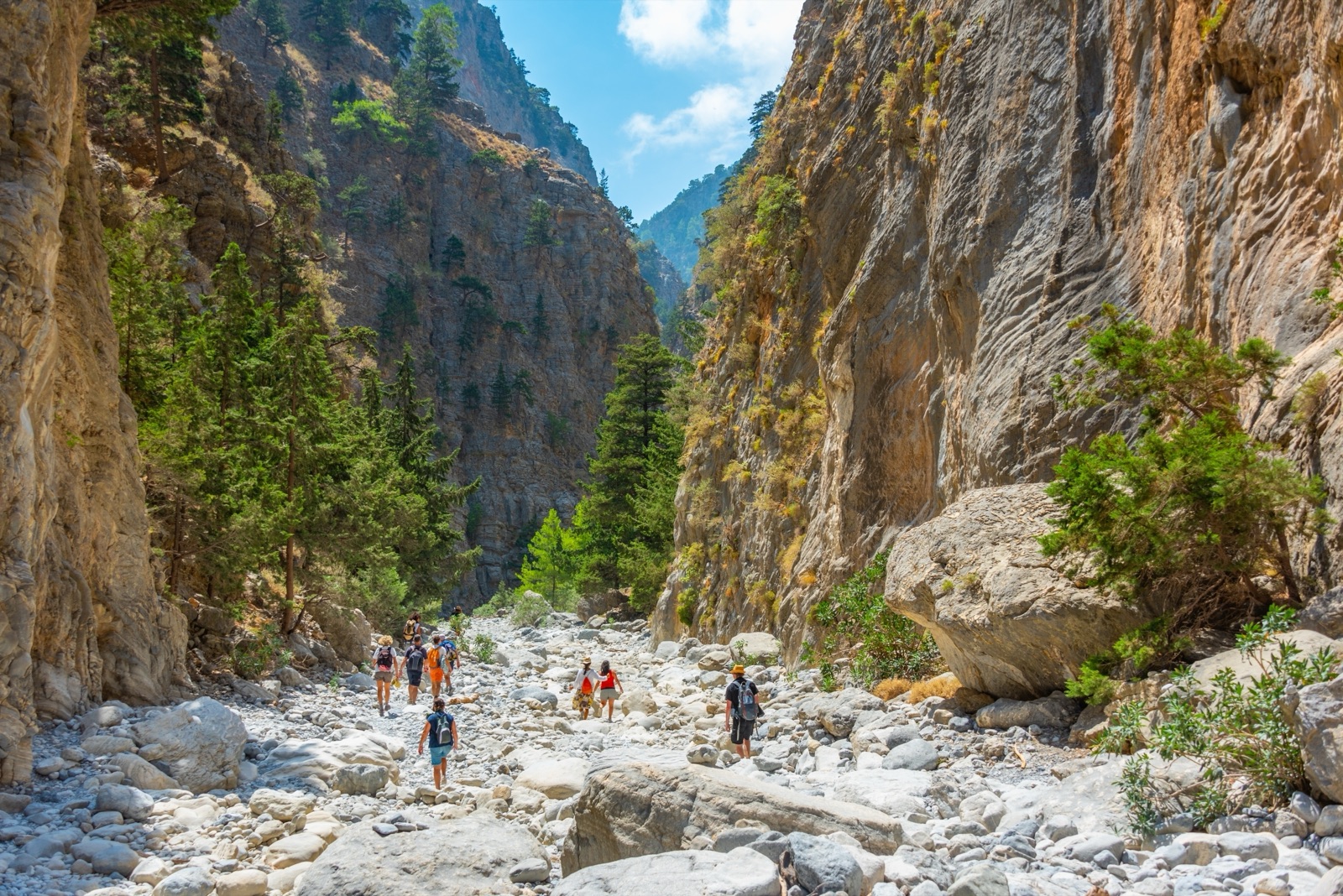
Best Time to Visit the Samaria Gorge: Opening Dates, Month by Month, Crowds and Closures
Samaria Gorge weather this week
Xyloskalo (1,227 m)
The five-day forecast for Xyloskalo, updated through the day.
Forecast data from MET Norway (CC BY 4.0), summarised by day.
The best time to walk the Samaria Gorge is late May to June or September to early October: the park is open, the days are long, the heat is bearable and there is little rain. July and August work too, but they are the hottest months and the walk is at its hardest then. The gorge is closed from November until it reopens in spring, so a winter visit is not possible at all, and the exact opening date depends on the state of the path after the winter rains. This guide goes through the season, each month in turn, the crowds, the closures and the best time of day to start.
The short answer
- The season. The national park opens from 1 May to 31 October, with entry from 7 am to 4 pm at its two entrances, Xyloskalo and Agia Roumeli.
- The sweet spots. Late May and June for flowers, running water and long days; September and the first half of October for warm sea and cooler walking.
- The hard months. July and August: the walk can be strenuous, especially at the peak of summer.
- The risky months. October and the first weeks of the season, when rain can close the gorge or damage the path.
- The best hour. The earlier the better: enter the gorge at Xyloskalo as early as possible, and in any case before the 13:00 cut-off for the full route.
If your dates are fixed, check the live forecast on our weather page a few days ahead, and read the getting there guide for the buses and the boat.
When the gorge is open
The Samaria Gorge is a national park with a fixed visiting season, not a trail you can walk whenever you like. The opening and closing dates come from the park’s rules:
- The normal season runs from 1 May to 31 October.
- An early opening is possible: if the weather is good and the path undamaged after winter, the gorge can open earlier, but not before 10 April; it can also close early if a storm damages the path. An early opening, not before 10 April, can be for the whole route or only for 2 km from each entrance.
- The winter closure is complete. The wooden bridges are removed in winter so the torrents do not sweep them away, and camping in any form and staying the night in the park are prohibited.
In practice, the start of the season moves. In 2026 the gorge opened late: a report in April 2026 said heavy rain at the start of that month had caused serious falls of rock and branches on the path, in places covering it completely, and the same report called an opening on 1 May, the usual date, unlikely. The park finally opened on Tuesday 19 May, for the whole route and from both entrances, once the yearly maintenance of the path, infrastructure and communications was finished (the report is dated 18 May 2026).
The end of the season can also be clipped. The 2025 season ended on Friday 31 October 2025, and NECCA reported that in 2025 the gorge was open for 151 days in all, which tells you that bad-weather days are part of the normal pattern.
What this means for planning: if your only chance to walk Samaria falls in the first fortnight of May, keep a back-up plan (see “If the gorge is closed” below). From late May to the end of September, the gorge is normally open every day unless the weather intervenes.
Daily opening hours
The hours matter as much as the dates, because the full walk is long and the park wants everyone out before evening:
| Rule | Time |
|---|---|
| Entry for the whole route, or part of it | 07:00 to 13:00 |
| After 13:00 from the north | the first 2 km only |
| After 13:00 from the south | the first 2 km only, until 16:00 |
| Everyone out of the park by | 18:00 |
From 13:00 to 16:00, visitors entering from the south may walk only the first 2 km, from Agia Roumeli to the Christos rest area. Because no one may stay overnight in the park, a late arrival is not allowed to walk the whole route. Keep your ticket to be checked at the exit, so the rangers know everyone who entered has left.
The early buses are timed for these hours: KTEL buses leave Chania for Xyloskalo every day at 05:00, 07:45 and 08:45, and the return boats leave Agia Roumeli at 17:30 for Chora Sfakion or Sougia.
Month by month
There is no climate station inside the gorge. The nearest HNMS climate table is for Chania Souda, a north-coast station at 148 m, for the period 1958–2010, so treat its figures as the regional pattern, not the gorge itself. The walk starts at 1,227 m at Xyloskalo, where mornings are cooler, and ends at sea level on the south coast, where afternoons can be hotter.
| Month | Gorge open? | Souda average high | Souda average low | Rain | Rain days |
|---|---|---|---|---|---|
| April | only if opened early | 20.0 °C | 11.4 °C | 31.5 mm | 7.7 |
| May | yes, from the opening date | 24.5 °C | 15.0 °C | 13.5 mm | 4.2 |
| June | yes | 28.9 °C | 19.0 °C | 3.4 mm | 1.2 |
| July | yes | 30.7 °C | 21.2 °C | 1.0 mm | 0.4 |
| August | yes | 30.4 °C | 21.2 °C | 1.4 mm | 0.6 |
| September | yes | 27.4 °C | 18.7 °C | 15.4 mm | 3.2 |
| October | yes, to 31 October | 23.5 °C | 15.7 °C | 67.7 mm | 9.3 |
| November | closed | 19.6 °C | 12.4 °C | 77.0 mm | 11.2 |
April
The gorge is normally closed. In a dry spring it may open after 10 April, sometimes only for short stretches from each end. On the plateau above, the Region’s UNESCO-sites project notes that in winter it is often entirely covered in snow; in spring it has countless flowers and seasonal marshes. April is a fine month for western Crete, but not one to count on for Samaria.
May
May is the opening month, and once the gorge is open it is one of the best times to walk. The air is mild at the top, the river still carries water in places and the springs are flowing. The risk is the start date itself: as 2026 showed, a wet spring can push the opening back by weeks. Average rain at Souda is 13.5 mm in May, over about 4.2 days.
June
June is arguably the best single month. Days are long, rain is rare (1.2 rain days on average at Souda) and the heat has not yet peaked: the Souda average high is 28.9 °C. The gorge gets busier as the month goes on.
July and August
The hottest and driest months: average highs of 30.7 °C and 30.4 °C at Souda, and almost no rain. The walk is shaded in places by the high walls and pines, but the lower gorge and the last stretch to Agia Roumeli can be very hot by early afternoon. The gorge closes when visitors’ safety is at risk, for example in a heatwave or extreme weather. If you walk in high summer, start on the first bus, carry plenty of water (there are several springs inside the gorge where you can refill your water bottle), wear a hat and sunscreen, and walk slowly. The reward at the bottom is a swim in the Libyan Sea.
September
September is the other sweet spot. The average high drops to 27.4 °C, the sea is at its warmest, and rain is still uncommon (3.2 rain days on average). Late in the month the first autumn storms can arrive: on 30 September 2026 the gorge was closed at both entrances because forecast rainfall exceeded the safety thresholds.
October
October is cooler and quieter, with an average high of 23.5 °C at Souda, but it is the month when rain returns: 67.7 mm on average over about 9.3 days. Closures become more likely, and even on days when the gorge is open, autumn wind can stop the boats leaving Agia Roumeli, so you might have to stay the night. Walk in the first half of the month if you can, and keep a spare day.
November to March
The park is closed. The bridges are out, the river runs high and the path is left to the winter torrents. The Imbros Gorge, an easier walk further east in Sfakia, is the usual winter substitute (see below).
How busy is the gorge?
Samaria is popular, but its numbers are spread over a long season. Kathimerini reported that about 1,000 people a day visit the gorge on average; the park’s older website put the number of walkers at about 800 a day.
Year by year, figures from Crete’s Tourism Observatory give 155,396 visitors in 2018, 159,051 in 2019 and 56,287 in 2020, the year of pandemic restrictions. There were 94,985 visitors in 2021 and 168,593 in 2022, the highest of those five years. NECCA’s figure for 2025 was 119,138 visitors over 151 open days.
What this feels like on the path:
- The first hour is the busiest. Most walkers arrive on the morning buses and organised coaches and start down from Xyloskalo together. The steep zigzags of the first 2 km can feel crowded.
- The crowd thins out. Within an hour or two people spread out by pace, and the middle of the gorge rarely feels packed.
- The Gates are a bottleneck. Everyone stops for photographs at the narrowest point; arrive there before the late-morning wave from the south.
- Agia Roumeli fills up in the afternoon. By mid-afternoon most walkers are in the village waiting for the 17:30 boat.
Busier months are June to September; May and October are quieter. Weekends make less difference than you might think, because most walkers are holidaymakers.
Weather closures: how they work
The gorge is a narrow canyon with steep sides, and the park closes it when the weather makes it dangerous. The gorge can close for a day or more if rain or a heatwave is expected; the decision is taken the day before. Closures follow the weather forecast: on 30 September 2026 the gorge was closed at both entrances because forecast rainfall exceeded the safety thresholds, with an update promised at 06:30.
The park has added safety measures in recent seasons:
- In 2026, for the second year running, a nowcasting service gave warnings of intense or extreme weather up to two hours ahead at critical points of the gorge.
- From the first day of the season, medical and nursing staff are present.
- Free helmets are provided at both entrances; wearing one is optional but strongly recommended.
Under the park’s regulation, visitors take personal responsibility for their own safety inside the park, so it is worth reading the safety section of the walking guide before you go.
How to check: look at the ticket website the evening before and again early in the morning. If you have booked a tour, the operator will tell you if the day is cancelled.
The boats change with the season
Your day ends with a boat, and the boat timetable has its own seasons. The boat service is limited in winter and becomes daily at the beginning of April. Once the gorge opens, boats between Chora Sfakion, Loutro and Agia Roumeli run about 2–3 times a day, and the Paleochora–Sougia–Agia Roumeli route once a day.
In the autumn timetable, boats leave Agia Roumeli for Loutro and Chora Sfakion at 08:45, 10:30, 11:30 and 17:30. From 7 September to 31 October 2026 the 17:30 boat from Agia Roumeli to Sougia continues to Paleochora. Boats may be delayed or cancelled in bad weather, which matters most in October.
Best time of day
- Start early. The park’s advice is simple: enter the gorge at Xyloskalo as early as possible. The first bus from Chania arrives in the cool of the morning, and the upper gorge is still in shade.
- Do not cut it fine. Entry for the full route closes at 13:00, and an average crossing takes about 6–7 hours.
- Plan for the 17:30 boat. Most walkers aim to reach Agia Roumeli by mid-afternoon, with time for a swim and a meal.
- Light for photographs. The high walls mean the gorge floor is in shade for much of the morning; the sun reaches the Gates and the lower gorge around the middle of the day. The Gates guide has more on photographing them.
If the gorge is closed on your day
- Imbros Gorge. Around 50,000 people visit the Imbros Gorge each year, because it can be crossed at any time of year, especially when the Samaria Gorge is closed. The Imbros Gorge article covers the route and the bus.
- The easy way from Agia Roumeli. If only the full route is restricted, the short walk up from the south may still be possible; the Gates guide explains it.
- The plateau. The Omalos plateau and the walks around Xyloskalo are covered in our Omalos and Gingilos guide.
- Another day trip. Our comparison of Samaria, Balos and Elafonisi helps if you want to swap days.
Organised tours and the season
Organised tours run through the park’s season and move with it. Tours leave from Chania, Rethymno and the Heraklion area, and they include the coach to the top and the ride back from the ferry port. If the park closes for weather, the day cannot go ahead, so check each product’s cancellation terms when you book. You can compare the options on our tours page or in the Samaria Gorge tours guide.
What to pack by season
- Spring (May to mid-June): a light fleece for the cool start at Xyloskalo, layers, and shoes with good grip for wet stones at river crossings.
- Summer (late June to August): sun hat, sunscreen, light long-sleeved top, a refillable bottle and salty snacks; there are no shops inside the gorge, so bring food.
- Autumn (September and October): a light waterproof, a warm layer for the morning, and money for a night in Agia Roumeli in case the boats do not run.
In every season, visitors need suitable clothing, footwear and sun protection (hat and sunscreen), and bring any medication you may need, and report health problems to the park rangers.
Frequently asked questions
Can I walk the Samaria Gorge in April? Only if the park opens early that year, which is never before 10 April and sometimes only for short sections. Most years it opens in May.
Is the gorge open in November? No. The season ends on 31 October, and the park is closed through the winter.
Is July too hot? It is hot but walkable for fit walkers who start early, drink a lot and rest in the shade. If you dislike heat, choose June or September.
What month is least crowded? May (after the opening) and October are quieter than the summer months, but they carry more risk of closures.
How will I know if the gorge is closed tomorrow? The decision is taken the day before, based on the forecast. Check the ticket site in the evening and again in the morning, or ask your tour operator.
Is there a best day of the week? Not really. Numbers depend more on the month than on the day.