Practical
Samaria, Balos Lagoon or Elafonisi: Which West Crete Day Trip?
From Chania, the three big day trips in the west of Crete are very different days. The Samaria Gorge is a walking day: about 16 km downhill to the sea, 6–7 hours on foot, a €10.00 park ticket and a boat at the end, and only between 1 May and 31 October. Balos lagoon is a boat day: from Kissamos port it is about an hour’s sail, and the 2026 cruise that also stops at Gramvousa island costs €40, or €45 from mid-July to mid-September, plus a €1 natural-area fee. Elafonisi is a beach day: 76 km from Chania by road or KTEL bus, with a short walk from a barrier to the famous pink-tinged sand.
So the choice is less about which is “best” and more about what kind of day you want. If you are fit, it is the season and you want one big active day, walk Samaria. If you want clear lagoon water, a castle and no driving, take the boat to Balos. If you want an easy beach day with children, go to Elafonisi. Across a week, you can do all three.
The three days at a glance
| Samaria Gorge | Balos lagoon | Elafonisi | |
|---|---|---|---|
| What it is | a gorge walk in a national park | a lagoon in the north-west, reached from Kissamos | a beach and islet in a Natura area |
| Getting there | bus or coach to Xyloskalo, boat back from Agia Roumeli | bus to Kissamos port, then boat; or a rough forest road | car or KTEL bus from Chania |
| Effort | a long, rocky descent | easy, apart from the heat | easy |
| Main cost | €10.00 park ticket, plus bus and boat | €40 cruise with Gramvousa (€45 in high summer), plus €1 fee | transport and parking |
| Season | 1 May to 31 October | 2026 cruise prices run from late April to 31 October | a beach, so best when the sea is calm and warm |
| Best for | walkers | lagoon swimming and a castle | families and a lazy day |
Samaria Gorge: the walking day
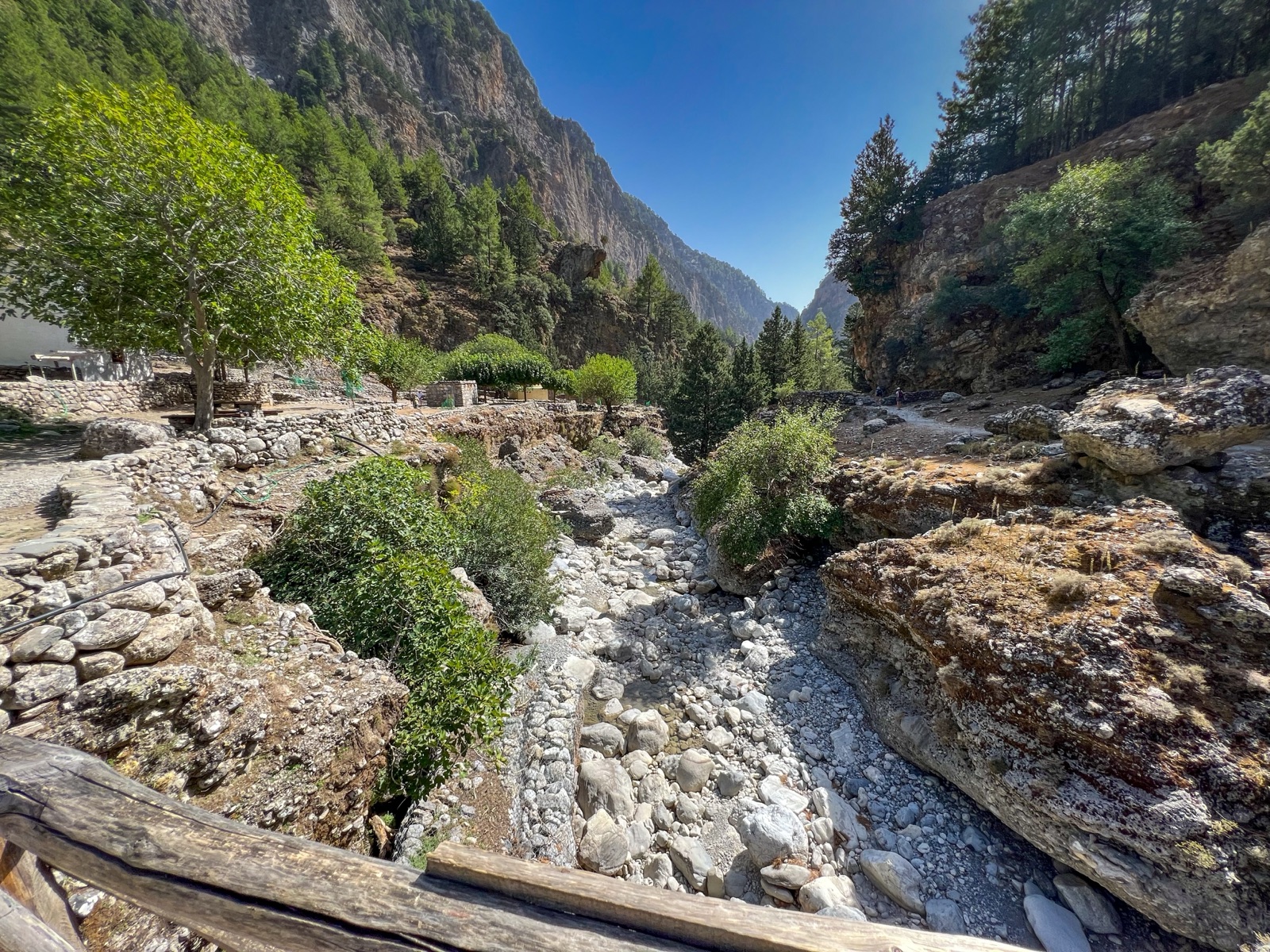
Samaria is the one that asks the most of you. The path inside the gorge is 13 km, plus 3 km from the south entrance to Agia Roumeli, and the natural direction is downhill, from Xyloskalo at 1,227 m to sea level. The park describes the path as mostly rocky, crossing the river several times on small wooden bridges or stepping stones: not an easy walk, but not only for experienced hikers.
The day is a one-way journey. You go up to the Omalos plateau by bus or coach, walk down to Agia Roumeli, a village with no road, and leave by boat. That makes timing everything, and it is why the day starts very early. Our guide to getting to the Samaria Gorge sets out the buses, entry times and the boat back, and walking the Samaria Gorge describes the route itself.
The costs are straightforward: an individual park ticket costs €10.00, bought online from NECCA, plus the bus up and the boat and bus back, or a single price for an organised day from Chania.
The main risk is the weather. The park can close the gorge for a day or more if rain or a heatwave is expected, and the decision is taken the day before. That is the strongest argument for doing Samaria early in your week, so there is time for a second attempt.
Balos lagoon and Gramvousa
What you see
Balos is a lagoon in the far north-west of Crete, reached from Kissamos. KTEL’s tourist guide describes it as a lagoon with crystal clear waters and red sand, and Gramvousa, the small island offshore, as crowned by a fortified castle of the sixteenth century. The area is protected: the boat trip from Kissamos passes through the EU’s Natura 2000 network.
It is a place for swimming and for the view over the lagoon rather than for a long walk. The castle on Gramvousa adds a history stop if you take the cruise that calls there.
By boat from Kissamos
KTEL’s suggested route is the bus from Chania to the port of Kissamos, then the boat. A Kissamos ticket agent’s page for the 2026 season, last updated on 19 September 2026, lists these daily departures from Kissamos port:
- Balos and Gramvousa: leaves at 10:35, back at 17:50. €40 from 24 April to 14 July and from 16 September to 31 October; €45 from 15 July to 14 September.
- Balos only: leaves at 10:25, back at 15:30, not at weekends in September and October; a second boat leaves at 13:15, back at 18:30. €36 in the lower season, €40 from 15 July to 14 September.
On top of the fare there is a natural-area fee of 1 euro per person, which can be paid on board. The crossing takes about an hour. At Balos, passengers land and board by a floating platform, and it takes about 10 minutes to walk from there to the beach. There is a large free car park at the port if you drive to Kissamos.
Treat these as 2026 figures from one agent: fares and times change from year to year, so check with the operator or an agent in Kissamos before you go.
By road
You can also drive, but it is not the easy option it looks on a map. In February 2026 the head of Crete’s car-hire association told the local press that road access to Balos is by a forest road that does not meet basic safety standards. He said heavy traffic, poor road conditions and frequent breakdowns can turn the drive into an ordeal lasting hours. The same report says the Municipality of Kissamos collects a fee of one euro per visitor.
If you do drive, check your hire contract for unsurfaced roads, go early and carry water. For most visitors, the boat is simpler.
Is it worth it?
If you like the sea, yes, but be realistic about the heat and the crowds: in February 2026 the local press described an uncontrolled influx of visitors to Balos. The boat that includes Gramvousa gives you the castle and a second stop; the Balos-only boats give you more time at the lagoon for slightly less money.
Elafonisi
Getting there
KTEL gives Elafonisi as 76 km from Chania, in the far south-west of the island, and runs buses on a Chania–Elafonisi route. By car it is a long drive, but it lets you choose your own hours. Either way, it is a full day from Chania.
The barrier and the walk
Elafonisi changed in August 2023. Because cars were being parked on the dunes, a barrier was put up where the asphalt ends, about 450 m from the shore, and vehicles no longer drive down to the beach. Visitors walk the rest of the way, a distance of about 350 m. According to NECCA, the national agency responsible for the area, the beach receives more than 5,000 visitors a day, and the municipalities cited heavy visitor numbers and uncontrolled parking when they asked for the barrier.
In practice that means parking before the barrier and walking in with everything you need for the day. Pack light, and bring the shade you want to sit under.
The beach and the islet
Elafonisi is really two places: the beach on the Cretan shore and a small island just off it. When the weather is fine, you can walk out to the island through the shallow water. The island is a protected nature reserve, known for its pink sand, which is created by deposits of pigmented microorganisms washed up by the tide and waves.
The Region of Crete lists Elafonisi as a Blue Flag beach with a lifeguard and restaurants nearby, but with no natural shade. KTEL notes that the area is part of the Natura protected network because of its dunes, sand lilies and junipers, and that endangered loggerhead turtles and many other species nest on the beach. The dunes with their junipers are the main feature the Natura site protects, so stay on the paths and off the dunes.
A place with a history
On the highest point of the island there is a plaque. On Easter Sunday, 18 April 1824, during the Greek War of Independence, several hundred Greeks, mostly women and children, who had taken refuge on the island were killed there by Ottoman soldiers. It is worth knowing as you walk across the shallows.
Is it worth it?
For families and for anyone who wants an easy day in the water, Elafonisi is the simplest of the three: no fixed boat, no long walk, shallow water and a lifeguard. The trade-offs are the long drive, the lack of natural shade, and the crowds in high summer.
Without a car
All three can be done by public transport from Chania, which is useful if you would rather not drive mountain roads or park at a busy beach.
- Samaria: early KTEL buses run from Chania to Xyloskalo, and the boat and bus bring you back in the evening. It is the most tightly timed of the three.
- Balos: KTEL’s route is the bus from Chania to the port of Kissamos, then the boat. Some ticket agents sell the boat with a bus transfer from the Chania area.
- Elafonisi: KTEL runs a Chania–Elafonisi route. Check the current printable timetable on KTEL’s website, as the service varies through the year.
What to pack for each
- Samaria: walking shoes with good grip, food, a refillable bottle for the springs, sun protection, your park ticket, and swimwear for the sea at Agia Roumeli.
- Balos: swimwear, a towel, sun protection, water and something to eat, plus cash or a card for the natural-area fee and lunch.
- Elafonisi: shade of your own, plenty of water, sun protection and water shoes or sandals for wading across to the islet; everything has to be carried from the car park.
If Samaria is closed on your day
Because the park can close the gorge the day before for rain or heat, it helps to have a plan B. A beach day is the obvious swap, but if you still want a gorge, the Imbros Gorge in Sfakia is shorter, ends on a road and is traditionally walkable when Samaria is closed; our article on the Imbros Gorge explains the ticket and the route. If a storm closed Samaria, it is no day for Imbros either, so check the forecast. And if the gorge is open but the full descent feels like too much, the easy way up from Agia Roumeli is covered in our guide to the Gates and Agia Roumeli.
Effort, cost and time compared
Effort. Samaria is in a different league: a full day on foot, much of it on rocky ground. Balos and Elafonisi are easy by comparison, though the summer sun is fierce and Elafonisi has no natural shade.
Cost. Samaria’s park ticket is €10.00, and the bus and boat come on top; an organised day bundles them. The Balos cruise is €36 to €45 depending on the boat and the season, plus the €1 fee. Elafonisi costs whatever you spend on fuel or the bus, parking and lunch.
Time. All three are full days from Chania. Samaria starts earliest, because of the bus ride up and the entry window for the full route. Balos is tied to the boat times. Elafonisi is the most flexible: you set off when you like and leave when you have had enough.
Planning. Samaria needs the most: a ticket, a bus or tour, and a boat. Balos needs a boat booking in summer. Elafonisi needs very little beyond an early start to beat the heat.
Season and weather
- Samaria opens from 1 May to 31 October, and can open earlier after a good winter, but not before 10 April. It closes at short notice for rain or heat, and in autumn wind can stop the boats from Agia Roumeli even when the gorge is open.
- Balos depends on the boats. The 2026 price list runs from late April to 31 October, and any boat trip depends on the sea on the day.
- Elafonisi is a beach, so it is at its best in settled, warm weather. With no natural shade, a hot midsummer afternoon is hard work for small children.
Fitting all three into a week
The easiest way to see all three is to base yourself in or near Chania and spread them out with rest days in between.
- Early in the week: Samaria. Do it first, so that a weather closure leaves you time to try again. Stay a night on the south coast if you can; the park itself advises an overnight stay in Agia Roumeli.
- Midweek: Elafonisi. A gentle beach day is the right thing after the gorge, when your legs are tired.
- Later in the week: Balos by boat. Book the boat a day or two ahead in summer, and choose between the Gramvousa cruise and a Balos-only boat.
If you are staying further west, Kissamos is worth considering as a base: the Balos boats leave from its port, and Elafonisi lies in the same municipality. Samaria is then a longer trip, and an organised day with transport may be easier than the public bus.
If you only have one day
- Choose Samaria if you are fit, it is between May and October, and you want the big experience. Check the forecast the evening before.
- Choose Balos if you want a lagoon, a castle and a boat trip, and you do not want to drive a forest road.
- Choose Elafonisi if you are travelling with small children, want the least planning, or are not confident on long walks.
Tours
For Samaria, the organised days from Chania handle the hardest part, the transport at both ends. The full-day trek from Chania includes the coach to Omalos and breakfast, and lets you walk at your own pace to Agia Roumeli. The tours page lists the Samaria trips, and the full listing of Samaria hikes and transfers, with live prices. For Balos, the boats themselves are the tour, and agents sell the tickets, some with a bus transfer from the Chania area.
Frequently asked questions
Is Balos or Elafonisi better?
They suit different days. Balos is a boat trip to a lagoon with a castle island nearby; Elafonisi is a beach you can drive to, with shallow water, a lifeguard and pink-tinged sand. With children and no wish to plan, Elafonisi is easier; for a boat day and the famous lagoon view, choose Balos.
How do you get to Balos lagoon from Chania?
KTEL suggests the bus from Chania to the port of Kissamos and then the boat. In 2026 the Balos and Gramvousa cruise leaves Kissamos at 10:35 and returns at 17:50, and the crossing takes about an hour. You can also drive, but access is by a forest road in poor condition.
Is there an entrance fee for Balos?
Yes. The Municipality of Kissamos collects a fee of one euro per visitor, and the Kissamos ticket agent’s page lists a natural-area fee of 1 euro per person for boat passengers, payable on board. Check the current amount locally.
Can you drive to Elafonisi beach?
You can drive to Elafonisi, but not onto the beach. Since August 2023 a barrier where the asphalt ends has kept vehicles out, and you walk about 350 m to the sand. KTEL also runs buses from Chania.
Why is the sand pink at Elafonisi?
The colour comes from deposits of pigmented microorganisms, which live alongside the native seaweed and are washed up by the tide and waves. The island is a protected nature reserve, so leave the sand where it is.
Can I do Samaria and Balos on the same day?
No. Each is a full day from Chania: Samaria starts before dawn and ends with an evening boat and bus, and the Balos cruises leave Kissamos between mid-morning and early afternoon.